

 Office
 As we begin the new year, we have gathered the thoughts of our design team to collect some of the trending design ideas that they expect to shape workplaces in 2026. There are a number of factors that influence the way offices are designed from year to year but certain topics, like sustainability and hybrid working, will always be important considerations within the workplace.
Increasingly offices are shifting towards functionality and connectivity, reflecting the growing need for office space to offer something more than just desks and meeting rooms. We’ve also seen how tenants are driving the demand for more considered, long-term solutions that offer more engaging workplace experiences and enable them to establish a destination that appeals to their staff
These design trends are the ones that we expect to see across more workplaces in 2026, as well as some that are already influencing design briefs for new projects.
Sustainability & Regeneration
In 2026, sustainability is going to move beyond the tokenistic gestures and begin to be built into office layouts from the beginning rather than as an afterthought. Businesses are now more aware of greenwashing and are in pursuit of more substance behind their sustainability efforts.
The way we expect to see this trend take shape is through intelligent specification of materials and finishes. Companies are now more interested than ever in using low-VOC finishes, traceable materials and modular systems in their offices. A big driver behind this is that it enables them to keep track of their carbon footprint as well as simplify the process of the disassembly or reuse of specific products. While many of these things in the past would have been specialist requests, they are becoming more standardised and a much more important consideration for many businesses.
Materials are always an integral part of an office design but there’s an increasing appreciation of materials like reclaimed timber, recycled metals and up-cycled upholstery being introduced into professional workplaces. These materials help to reduce waste but can still add real depth and character to offices.
Our focus as a design studio is to try and consider long-term adaptability where possible and aim to reduce the environmental impact of the spaces we design. Working with our clients on these more regenerative processes will contribute to making more sustainable design choices and ideally, enable clients to retain elements of their office fitter when they relocate in the future.

Flexible, Adaptive & Multifunctional Spaces
From a commercial design perspective, multifunctionality is one of the most valuable trends shaping office environments right now. Businesses need flexibility within their offices as the traditional fixed layouts no longer reflect how people work.
We know that working policies are varied from business to business and even working hours in the office can differ from team to team. With these variations in mind, it is important to have enough flexibility to enable choice within your office.
Gensler’s 2025 Global Workplace Survey states that “employees with a high degree of choice in where and how they work are 2.5x more likely to say their workplace supports both individual and team productivity.”
We have consistently seen how adaptable environments are linked to workplace effectiveness and how they help to shape employee confidence. Staff are still looking for choice at work and that comes from enabling spaces to be reconfigured and flexed based on the needs of the staff.
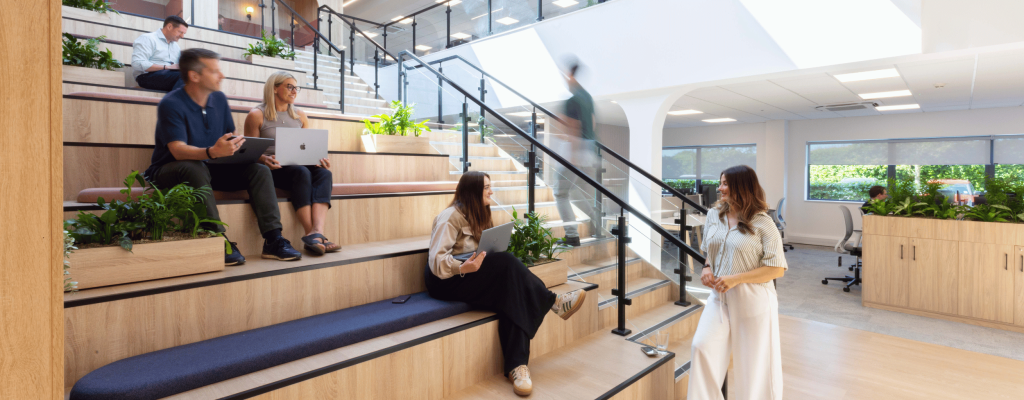
Many of the offices we are designing are integrating adaptability by using modular furniture and reconfigurable zones. Introducing these elements helps to support different modes of work throughout the day. We have seen how this approach maximises space utilisation and guides staff to work in different ways based on their surroundings.
Warm Minimalism & Tactile Textures
While performance and flexibility are essential, how a space feels does still matter and it is important that we don’t remove tactility and colour from our workplaces.
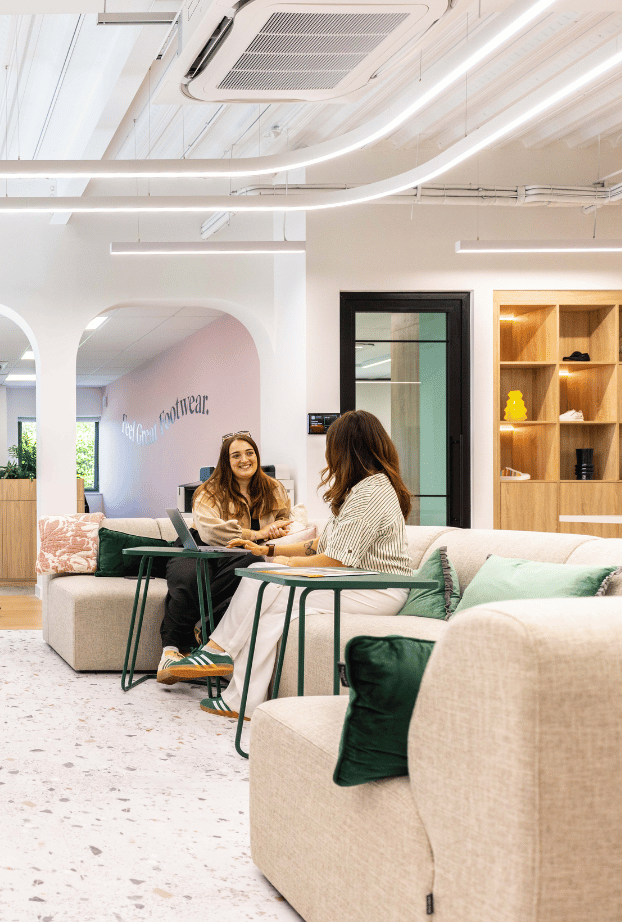
Minimalist layouts are still popular and they do serve a purpose but the more clinical palettes that once dominated workplace interiors are being replaced by a warmer, more tactile approach. We’re referring to it as “warm minimalism”which essentially combines clean, considered layouts with richer textures, softer forms and more inviting material choices.
Materials such as boucle, velvet, brushed metals and layered laminates introduce depth without visual clutter. Curved furniture and softened edges replace rigid rectilinear forms, helping spaces feel more fluid and comfortable.
Materials will become even more desirable in 2026 and introducing a blend of different materials will help inject some life and emotion into offices in an age when we’re talking a lot about functionality and utilisation. This trend is more of an acknowledgement that we know people respond better to spaces that feel human and how that creates warmth within a professional environment.
Workplace Technology
We are so reliant on technology in our daily lives that it feels wrong to call it a trend but the adoption of technology into buildings and commercial spaces has fundamentally changed.
Technology in 2026 is less about gadgets and the latest innovations and more about smart buildings and seamless integration. Rather than standing out as feature elements, technology is being integrated into furniture, joinery, ceilings and architectural details. There are numerous workplaces elements being designed to respond intuitively to the way we interact with spaces.
Features like programmable lighting helps to support our circadian rhythm, occupancy sensors allow us to monitor which parts of the office are in use and smart HVAC systems that regulate temperature are increasingly common.
The uptake of technology within commercial interiors is beneficial for both businesses and the landlords. Companies that occupy the space benefit from environments that feel more comfortable and supportive. Landlords are using technology to improve energy efficiency and capture valuable data on space utilisation. For many years workplace tech was more about the latest fad, but we have worked with a number of businesses and developers that are actively introducing new and exciting technology into their spaces.
Designing workplaces in 2026
Workplaces in 2026 need to do more than function efficiently. If we saw anything in 2025, it was the fixation on workspace being pushed to its performance limit and occasionally this need for utilisation crept into the look and feel. Offices have to support the people who work there fundamentally but we also believe that they need to be on-brand and provide people with an experience.
As competition for talent, customers and tenants intensifies, spaces that make confident design decisions stand apart. Bold, considered choices help to express identity but more importantly, they add character to the workplace and 2026 could be the year where office design moves back towards creating excitement at work and making us more connected with our colleagues.
Based on some of the schemes we’re already working on and some of the briefs we’ve seen in the early part of the year, we believe that the most successful commercial spaces will be those that balance performance with personality. There has to be a bit of a pivot on creating environments people want to return to and intelligent design will help us to make workplaces experience-rich environments that staff want to be in.

It All Starts With a Conversation
If you have a question, if you are looking for some bespoke advice, get in touch with our experts today, we’d love to hear about your project.
For a no-obligation chat about your office needs, complete the form below and one of our specialists will be in touch.